
 EN
 FR
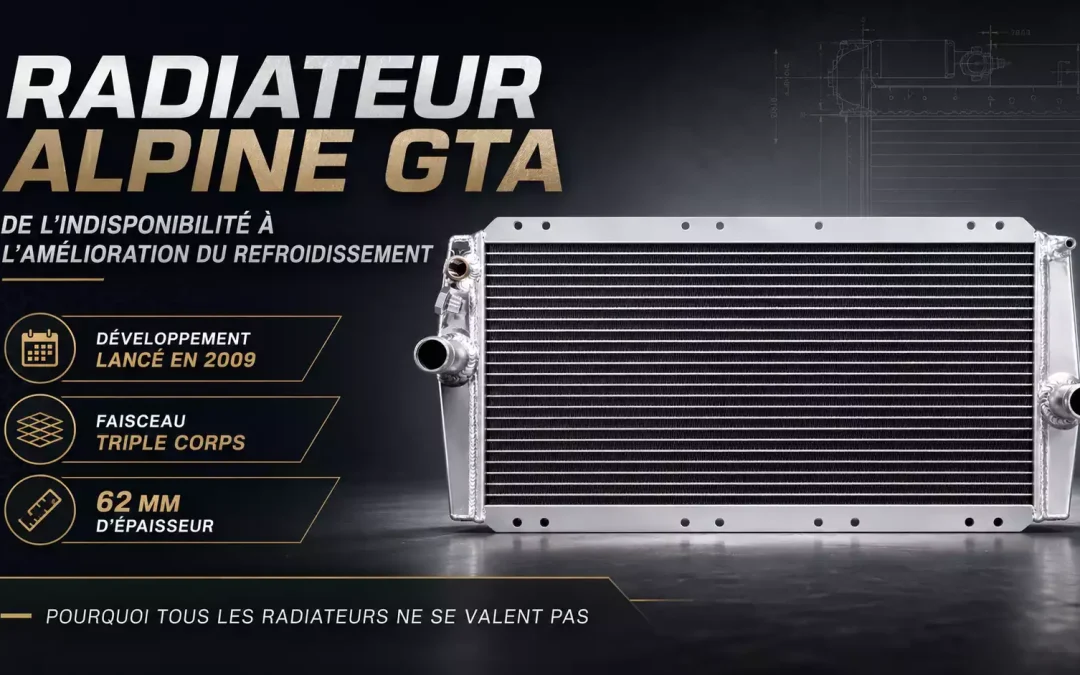
the cooling radiator of the Alpine GTA V6 and GTA V6 Turbo had become unavailable. Founded in 2007, Mespiecesauto had already developed several specific radiators, notably for the Renault 21 Turbo and Alpine A310. But the Alpine GTA presented a particular challenge: very tight packaging, difficult access, and a real need to improve cooling without altering the original installation. In this article, we look back at the development of this radiator, the difficulties encountered with the first prototypes, the technical choices made, and the reasons why improving a radiator never simply comes down to “fitting a bigger one”.
Back to 2009: a radiator that had become impossible to find
At the time, the availability shortage was real. No serious solution really existed to correctly replace the original radiator of the Alpine GTA V6 and GTA V6 Turbo.
We therefore proposed, through the forum Avenue de Bréauté, to develop a specific re-manufacture. We then had an original radiator, a few packaging elements, and very little additional technical information.
The cooling problem on the Alpine GTA is multiple. It relates at once to the location of the radiator, the available space, the airflow, the possible presence of air conditioning, and the actual capacity of the core to dissipate heat.
When we talk about improving cooling, two notions are often in opposition: increasing the exchange surface and respecting the original packaging. The more efficient a radiator is, the more it generally requires a large exchange surface. But on an Alpine GTA, the available space is extremely limited.
Despite these constraints, Mespiecesauto launched the development of a first prototype in September 2009.
A promising first prototype, but impossible to fit
The first prototype was visually successful. On paper, it seemed to meet the need. Yet our tester at the time quickly confirmed that fitting was impossible due to the space taken up by the side tanks.

The problem was real: a side thermal switch was necessary, but the available space did not allow a conventional tank geometry. We had, in a way, to fit a square into a triangle.
The solution was to redesign the side tanks with a bevelled shape. This geometry had several advantages: it kept the location of the switch, respected the maximum available space, and above all did not needlessly reduce the size of the core.

This was an essential point. Reducing the core to make fitting easier would have been technically simpler, but thermally less interesting.
It must be acknowledged that the Alpine GTA V6 and GTA V6 Turbo is probably one of the most difficult cars in terms of access to the radiator. To validate the development correctly, we had deliberately chosen a tester with a car equipped with air conditioning. It would have been too easy to do without the condenser and the twin fans.
Correcting the design and validation in real conditions
After correcting the design and manufacturing a second prototype, the radiator could be fitted on the car and go out for testing.
The tester had previously experienced temperature problems, notably on track days. After several tests carried out in periods of intense heat, the result was particularly satisfactory: no more trace of overheating.
This step is important, because a radiator is not validated solely on a bench or by its external dimensions. It must be tested in its real environment: with its fitting constraints, its airflow, its fans, its cooling circuit and the car's conditions of use.
Improving cooling: volume is not the most important thing
One of the mistakes most frequently made when talking about radiators is to think that water volume is the main performance criterion. This is false.
In reality, a radiator does not cool because it contains a lot of water. It cools because it allows an efficient thermal exchange between the coolant, the tubes, the fins and the air passing through the core.
Volume can have an occasional benefit by increasing thermal inertia, but it is not enough to durably improve cooling. Once the coolant has risen in temperature, what really counts is the radiator's ability to dissipate heat continuously.
Key point: a high-performance radiator is not judged only by its thickness or its water volume. Its performance depends above all on the quality of the thermal exchange between the coolant, the tubes, the fins and the airflow.
The wetted perimeter: an often forgotten notion
This is where a much less well-known notion comes in: the wetted perimeter.
The wetted perimeter corresponds to the length of internal wall actually in contact with the coolant in the tubes of the core. The larger this internal contact surface, the more efficient the thermal exchange between the coolant and the radiator can be, provided of course that circulation remains correct.
Two radiators with similar external dimensions can therefore have very different performances depending on the internal geometry of the tubes, their number, their section, their arrangement and the quality of the core used.
It is for this reason that we chose a triple-core. The objective was not simply to increase the thickness of the radiator, but to improve the exchange capacity while keeping a fitment compatible with the very constrained environment of the Alpine GTA.

Double core, triple core: why it is not just a question of thickness
For comparable packaging, a triple core allows the coolant to be better split into several passages. A larger proportion of the fluid then circulates close to a metal wall, which improves the thermal exchange potential.
In other words, the benefit of a triple core does not lie solely in adding a row of tubes. It also lies in multiplying the contact zones between the coolant and the exchange walls.
The volume of coolant located in the centre of the passage, further from the walls, becomes proportionally smaller. The radiator therefore does not merely contain more water: it makes better use of the coolant circulation to promote heat transfer.
A thicker core is not, however, automatically better. If poorly designed, it can generate excessive pressure loss, slow the circulation, or be poorly crossed by the air. Improving cooling therefore rests on a balance: exchange surface, coolant circulation, airflow, packaging and build quality.
A radiator developed for the Alpine GTA, not simply adapted
The Alpine GTA radiator developed by Mespiecesauto is not a generic adaptation. It is the result of a development carried out from an original radiator, real fitting constraints, corrected prototypes and vehicle testing.
The objective was twofold: to offer a solution to a real unavailability, while improving the cooling capacity without altering the original installation.
This approach perfectly illustrates our vision of re-manufacturing: not simply copying a discontinued part, but understanding its function, its constraints, its limits, and improving it when technically coherent.
Other radiators on the market: beware of the real dimensions
When a product works and meets a real need, it naturally ends up attracting envy. For more than fifteen years, we have seen various alternatives or reproductions of radiators appear for Alpine GTA V6 and GTA V6 Turbo.
But on a radiator, it is essential to look beyond the external appearance. Two radiators can look visually similar while offering very different thermal exchange capacity depending on the size of the core, its thickness, its internal design and the actual number of rows of tubes.
Some models are sometimes presented as radiators of the GTA Europacup type, whereas the stated dimensions indicate cores of about 45 to 55 mm thick. At these values, they are very probably double-core designs or cores offering a lower exchange capacity than a genuine thicker and correctly sized core.
As an example, here are dimensions measured on other radiators available on the market:
- 670 x 308 x 56 mm
- 630 x 265 x 45 mm
These differences are not trivial. A reduction in the frontal area or the thickness of the core can lead to a real loss of thermal exchange capacity. The cost price may be lower, but that does not necessarily mean that the final retail price is more advantageous for the customer.
Comparison of observed delivered prices
To compare correctly, you should not only look at the radiator's advertised price. The price actually paid by the customer is the delivered price, shipping included.
| Model compared | Observed delivered price |
|---|---|
| Radiator 1 – 45 mm core | 278.98 € |
| Radiator 2 – 56 mm core | 294.95 € |
| Radiator 3 – 45 mm core | 374.90 € |
| Radiator 4 – 60 mm core | 474.90 € |
| Radiator 5 – 60 mm core | 574.50 € |
As a reminder, the core of the Mespiecesauto Alpine GTA V6 and GTA V6 Turbo radiator measures 62 mm thick.
Its delivered price is 269.00 €.
Remember: price alone is not enough to compare two radiators. You have to compare the delivered price, but also the real dimensions of the core, its thickness, its internal design and its thermal exchange capacity.
Conclusion
The development of the Alpine GTA radiator shows that serious re-manufacturing does not come down to reproducing external dimensions. In the case of a component as sensitive as cooling, the geometry of the core, the airflow, the coolant circulation, the wetted perimeter and the fitting constraints are decisive.
This is the approach that guided the development of our Alpine GTA radiator: starting from a real need, solving the packaging problems, validating the fitment on a car equipped with air conditioning, then improving cooling thanks to a better-suited core.
FAQ – Alpine GTA V6 and GTA V6 Turbo radiator
My Alpine GTA V6 or GTA V6 Turbo is overheating: is it necessarily the radiator?
No, overheating on an Alpine GTA V6 or GTA V6 Turbo can have many causes. The radiator is an important part of the cooling circuit, but you should not jump to conclusions.
Before any replacement, it is essential to observe precisely the conditions in which the overheating appears:
- Does the temperature rise only when stationary, in slow traffic, or also on the open road?
- Does the fan switch on correctly?
- Does the coolant rise abnormally in pressure?
- Has the circuit been bled correctly?
- Are there other symptoms: coolant loss, bubbles, smell, smoke, very hard hoses, engine misfires?
Overheating can come from a radiator at the end of its life, with a clogged, oxidised or partially blocked core. But it can also be linked to poor bleeding, a faulty fan, poorly adjusted injection, a thermostat problem, insufficient circulation or, in some cases, a cylinder head gasket.
Contact us for diagnostic help. With some precise information, it is often possible to guide the investigation before needlessly replacing parts.
Should anything else be planned during the radiator replacement?
Yes, replacing the radiator is a good opportunity to check the whole cooling circuit. On a PRV engine, it is useful to clean the circuit, notably to try to flush out the sludge and deposits accumulated in the block.
Corrosion at the liner bases is a known problem on PRV blocks. During work on the cooling circuit, it can therefore be worthwhile to feed water into the block using a hose in order to flush out as much deposit and foreign matter as possible.
It is also recommended to check the condition of the hoses, particularly at the front of the vehicle. If you replace the radiator, it may be wise to also replace the front hose kit to avoid having to dismantle the area again later.
Does your radiator fit with the air conditioning condenser?
Yes, our Alpine GTA V6 and GTA V6 Turbo radiator fits with the air conditioning condenser. The development was specifically carried out taking this more demanding configuration into account.
Fitting is done by installing the condenser and the radiator, then the fan assembly. This validation with air conditioning was important, because it allowed the fitment to be checked in the most cramped environment, with the condenser and the twin fans.

Article written by Benjamin
Engineer and founder of Mespiecesauto
Specialist in reverse engineering, developer of parts for the Alpine GTA since 2007.