
 EN
 FR

R5 Turbo Cévennes brake disc: why holes?
On a fast car such as an Renault 5 Turbo or a Alpine A310, it is useful to have braking. In 2011, we were consulted to restart the manufacture of a disc that had become unavailable:
the famous R5 Turbo Cévennes type brake disc.
A look back at this re-manufacture, at the real benefit of a drilled disc, and at the different versions found on the market. Which one to choose? And above all, what distinguishes a truly technical disc from a disc simply drilled for appearance?
The R5 Turbo has, however, a generously sized braking system as standard: Four identical 260 mm brake discs, for a weight slightly under one tonne. On paper, it is hard to do much better.
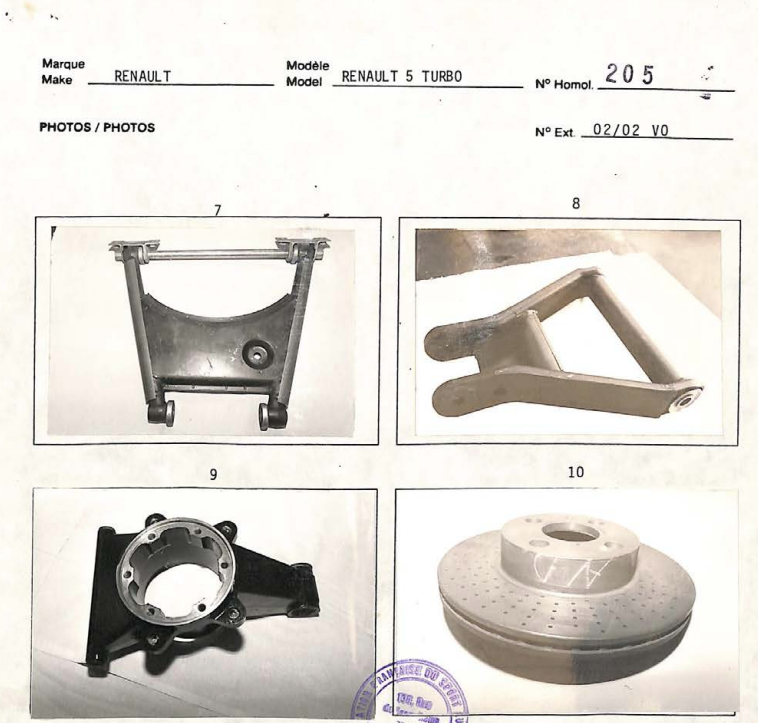
Yet the engineers of the Régie Nationale des Usines Renault had developed a specific disc, called Cévennes brake disc. The idea seems simple: start from an original vented disc and drill many holes in it. But as often in mechanics, what seems simple actually hides many details.
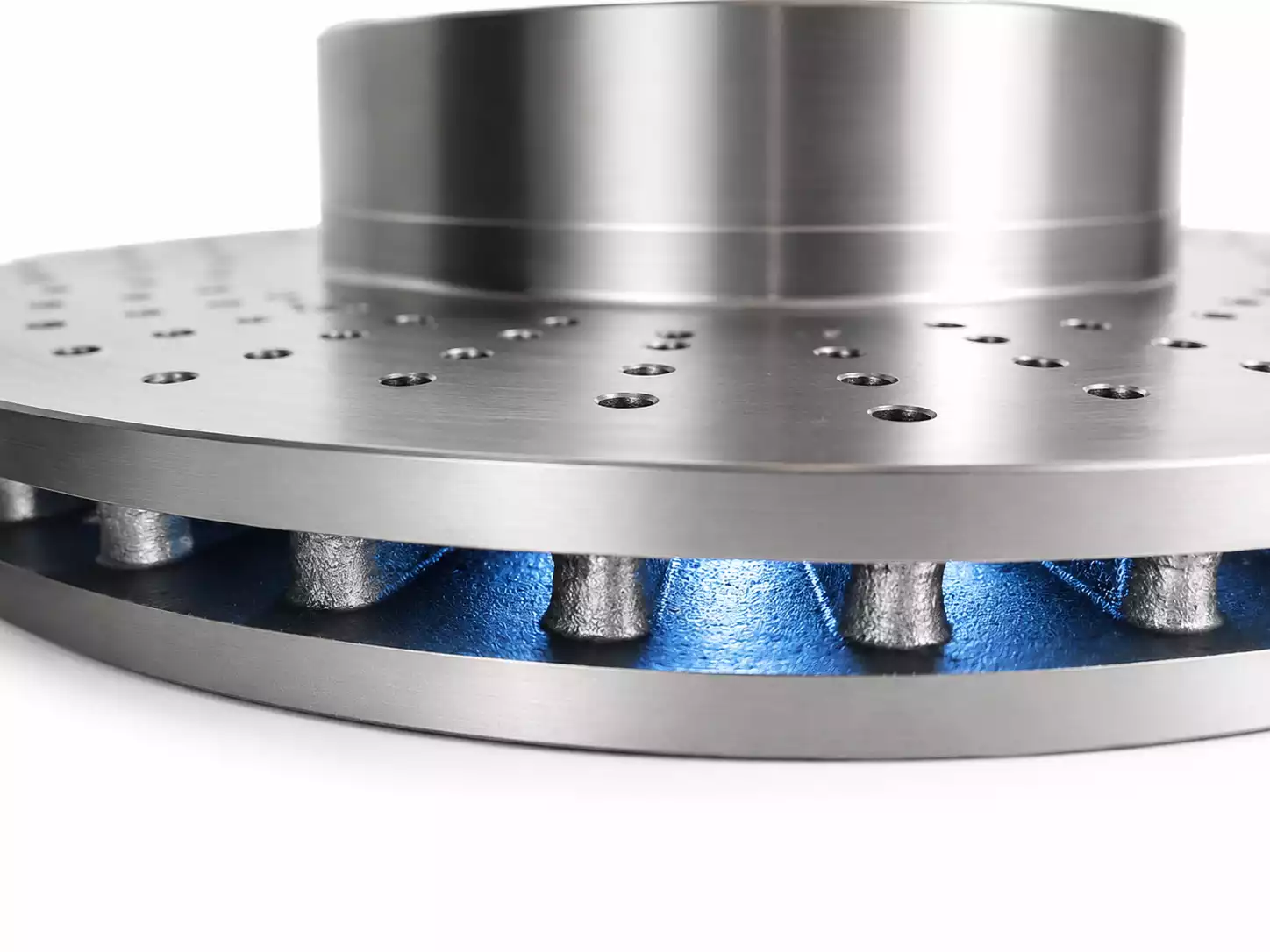
Holes, holes, always little holes
Contrary to what one might think at first, a drilled disc does not brake better simply because it is drilled. In reality, it is even almost the opposite.
A brake works through friction between the pad and the disc's friction face. If you drill the disc, you remove material. You therefore slightly reduce the surface available between the pad and the disc. Theoretically, the hole itself does not increase braking power.
In fact, it may even seem counterproductive.
So why drill a brake disc?
The benefit of the drilled disc lies elsewhere: above all, it helps maintain more consistent braking when conditions become difficult.
During heavy braking, the pad rises sharply in temperature. Under the effect of this heat, some linings can release gases, produce dust or form a thin film between the pad and the disc.
This phenomenon can reduce the actual contact between the two parts. The driver then feels less bite, less consistent braking, or even the beginning of fade.
The holes then act as evacuation zones. They allow gases, dust and friction residues to escape instead of remaining trapped between the pad and the disc. The contact stays cleaner, more direct,
and the coefficient of friction becomes more stable.
This also applies in the rain. A thin film of water can form on the disc's friction face. On a solid disc, the pad must first sweep away this water before regaining effective contact. The drillings break this water film and allow a more immediate bite on the first braking.
The holes also play a role in cleaning the pad surface. On each pass, the edges of the drillings slightly “refresh” the lining. This limits glazing, evacuates dust and renews the active surface.
This is often what gives a drilled disc that feeling of sharper bite, especially when hot or in sporting use.
The drilled disc should therefore not be understood as a disc that brakes better because it has less surface. It is the opposite: it loses a little friction surface, but it gains in contact cleanliness, consistency and braking stability.
The holes are not placed at random
On the R5 Turbo brake disc Cévennes, the drillings are not made just anywhere on the friction face. They are positioned in the bridges, that is, in the linking zones of the disc.
This detail is essential. A hole in a brake disc always creates a stress concentration zone. During repeated braking, the disc heats up, expands, then cools down. These thermal cycles create tensions in the material. If the holes are badly placed, too close to the edge, too large or poorly finished, they can become the starting points of cracks.
Drilling in the bridges allows these stresses to be better controlled. The drilled zone is linked to the internal structure of the disc, which limits local deformations and avoids unnecessarily weakening the braking face.
It is therefore not just a question of the number of holes. It is a question of positioning, diameter, distribution and finish.
A properly designed drilled disc must respect several rules:
- well-distributed holes?
- a consistent diameter?
- positioning suited to the structure of the disc;
- clean chamfers?
- no sharp edges?
- no drilling in a fragile zone.
This is the whole difference between a disc simply “drilled” for appearance and a disc genuinely designed for sporting use.
The real advantage of the drilled disc
The drilled disc is not necessarily more powerful on a single cold braking. Its benefit is above all to keep braking more consistent when the temperature rises, when the pads work hard, or when conditions are wet.
In summary, the drillings help to:
- evacuate the gases produced by the pad;
- evacuate water in the rain;
- evacuate friction dust;
- limit glazing of the pads;
- improve the bite?
- stabilise braking during sustained use.
But this gain only exists if the disc is properly designed. A bad drilling can do the opposite: weaken the disc, promote cracks and reduce its lifespan.
This is why the geometry of the Cévennes type disc is interesting. The idea was not to make holes to look nice, but to improve braking behaviour
while keeping a reliable structure.
On an R5 Turbo, already equipped with four 260 mm vented discs for a weight under one tonne, the goal was not to compensate for insufficient braking. The goal was to obtain more enduring braking,
more consistent and with more bite in sporting use.
How does Mespiecesauto re-manufacture the R5 Turbo Cévennes disc?
Re-manufacturing a vented disc does not simply consist of taking an existing disc and drilling holes in it.
To make a vented disc, you first need a specific foundry mould. And when we talk about foundry, we are not talking about one-off artisanal manufacture. At Mespiecesauto, this type of manufacture is done in batches of several hundred discs.
It is a heavy industrial process, with constraints of material, mould, cooling, heat treatment, machining and inspection.
The material used must be compliant and controlled. This is an essential point, because the quality of a disc is not always visible to the naked eye.
Two discs can have the same diameter, the same number of holes and the same external appearance, but behave very differently on the car.

The foundry is only the beginning
The foundry part is already complex, but it is only the first step.
Once the disc is cast, machining it is not enough to obtain a good part. The cast iron must be stabilised, because during cooling in the foundry, not all zones of the disc cool at the same rate.
The friction faces, the hat, the bridges and the internal fins have different thicknesses. The material therefore contracts differently depending on the zone. This creates invisible internal tensions. These tensions are not visible at assembly. A disc can appear perfectly correct, be well machined, well presented, and yet contain internal stresses.
The problem then appears on the car, during the first hard braking. Under the effect of heat, the material continues to work. The stresses are released. The disc can then warp, vibrate, create hot spots or wear unevenly.
Heat treatment: an invisible but essential step
Heat treatment serves to stabilise the cast iron after casting.

Furnace pass for heat treatment
The disc is heated progressively, held at temperature for a certain time, then cooled slowly and in a controlled manner. This step allows the material to relax
before its use on the car.
The objective is not simply to make the disc harder. A disc that is too hard can become noisy, aggressive on the pads or more prone to cracks. A disc that is too soft, on the contrary, will wear out very quickly.
The goal is to obtain a stable, homogeneous cast iron suited to braking.
Poorly stabilised cast iron can lead to:
- warping ;
- vibrations under braking?
- uneven wear?
- hot spots?
- deep scoring?
- excessive attack of the pads?
- the appearance of cracks in the stressed areas.
Abnormally rapid wear of the friction face, sometimes in just a few thousand kilometres, can be a sign of cast iron that is too soft, insufficient heat treatment or a poorly controlled metallurgical structure.
The quality of a disc therefore does not depend only on its shape or its machining. The stability of the cast iron is essential to guarantee even wear, consistent braking and a good lifespan.
Machining, drilling, chamfering and balancing
After the foundry and heat treatment come the finishing operations.

Machining a disc
The disc is machined to obtain the right dimensions, the right thickness and a consistent braking face. Then comes the specific drilling of the R5 Turbo Cévennes type disc. 156 holes to make and 312 chamfers. This operation must be carried out with precision, because each hole becomes a sensitive zone if the machining is poorly done.
Chamfering the holes is also essential. A sharp edge around a drilling can promote the appearance of cracks. The chamfer breaks this edge and better distributes the stresses.
Finally, the disc is balanced. This is a step that is sometimes forgotten, but important on a rotating part. A poorly balanced disc can generate vibrations, especially at high speed.
The manufacture of a Cévennes disc therefore does not come down to drilling. It is the whole process that counts:
foundry, material, heat treatment, machining, drilling, chamfering and balancing.
An appearance reproduction or a real technical re-manufacture?
A brake disc is not judged solely on its external appearance. Two discs can look perfectly alike, but have very different lifespans and behaviour depending on the quality of the cast iron, the heat treatment and the finishing operations.
This is the whole difficulty of re-manufacturing: it is not enough to copy a shape. You have to understand the function of the part, its stresses, its use and the original design logic.
The recommended press fit of 0.1 mm is advised for installation R5 Turbo brake disc Cévennes is a good example. Seen from the outside, they are “just” holes in a disc. In reality, behind these holes, there is a geometry, a material, a heat treatment,
machining and real technical logic.
The other discs available on the market
Over the years, other discs for Renault 5 Turbo have appeared on the market. They are generally a little cheaper, with a much lower number of drillings, often around 16 to 20 holes, sometimes accompanied by grooving.
At first sight, the price difference may seem attractive. But you have to look beyond the external appearance. These discs do not reproduce the geometry of the Cévennes type disc developed at the time by Renault Sport, particularly on one important point: the positioning of the drillings. On the Cévennes type disc, the holes are positioned in the bridges of the disc, that is, in the linking zones. On some reproductions on the market, the drillings are placed between the bridges. This choice can increase local stresses and make the disc more prone to cracking, especially in sustained use or with strong temperature variations.
The other point that alerted us concerns wear. Several customers came back to us after fitting this type of disc, with reports of very rapid wear, sometimes in less than 1,000 to 2,000 km,
even with pads that are not particularly aggressive. Such wear is not normal on a brake disc. It can reveal cast iron that is too soft, an unsuitable metallurgical structure, insufficient heat treatment or poorly controlled material stabilisation.
Of course, these discs can be slightly cheaper to buy, in the order of 50 to 60 € a pair depending on the case. But the real question is that of the actual cost in use. If the disc wears out very quickly, vibrates, gets marked or has to be replaced prematurely, the initial saving becomes much less attractive.
The difference is therefore not only about price or appearance. It comes down to the design, the number of drillings, their positioning, the quality of the cast iron, the heat treatment, the chamfering and the balancing. A brake disc is a safety part. On a car like the R5 Turbo, it is not simply about fitting a part that looks like the original, but a part whose manufacture respects the technical logic of the period assembly.

AI illustration of a disc with these problems
Fitting R5 Turbo Cévennes discs: which pads to use?
The big advantage of the R5 Turbo Cévennes type brake disc is that it fits in place of the original disc, directly on the original hub.
There is no modification to plan for: no adaptation of the hub, no modification of the caliper, no transformation of the assembly. It is a plug and play.
Regarding the pads, to obtain braking with a lot of bite and good consistency in sporting use, we recommend the use of Carbone Lorraine.
They are available from most specialist or general retailers.
Contrary to what one sometimes hears, this type of pad does not necessarily cause abnormal disc wear, provided the disc quality is suitable.
This is moreover the configuration used for several years by Benjamin, founder of Mespiecesauto, on his own R5 Turbo: Mespiecesauto R5 Turbo Cévennes type discs with Carbone Lorraine pads.
From our experience, this combination offers a very good compromise between bite, endurance and braking consistency, without premature wear observed on our discs.
Conclusion: a drilled disc, yes, but not just any way
The R5 Turbo Cévennes type brake disc is a good example of a part that seems simple at first glance, but which actually hides a real technical logic.
These are not just holes added to an original disc. Their number, their positioning in the bridges, their chamfering, the quality of the cast iron, the heat treatment and the balancing all play a role in the final behaviour of the disc. On a car like the R5 Turbo, already very well equipped with braking as standard, the benefit of the Cévennes disc is not to correct a defect, but to provide more incisive, more consistent braking better suited to sporting use.
Our re-manufacturing experience since 2011 has shown us that a brake disc must never be chosen solely on its appearance or its price. Two discs can look alike, but have very different lifespans, stability and behaviour.
It is precisely this difference that sums up our approach at Mespiecesauto:
not simply to reproduce a part, but to understand its function, its specifications and the constraints for which it was designed.
Discover our R5 Turbo Cévennes type brake discs
Re-manufactured according to the logic of the original assembly, with specific drilling in the bridges,
heat treatment, machining, chamfering and balancing.
A plug-and-play solution for the R5 Turbo, designed to provide more incisive braking,
more consistent and suited to sporting use.

Article written by Benjamin
Engineer and founder of Mespiecesauto
Specialist in reverse engineering, developer of parts for R5 Turbo since 2007